Latest blogs

Can AI Help Children Learn Hindi? Exploring the Future of Language Learning
Your child understands a question in Hindi, then answers in English. During a call with their grandparents, they ask you to translate. You want to help them practise, but fitting another lesson around school and homework takes some planning.For families in Hong Kong, finding time and company for Hindi conversation can require effort. An AI tutor that offers speaking practice at home sounds appealing.AI can help children practise parts of Hindi, including reading aloud and rehearsing simple conversations. Its usefulness depends on the tool, the child’s starting point, and the guidance an adult provides. AI Hindi learning for kids deserves a closer look, especially before parents treat an app as a complete language course.What does AI Hindi learning involve?“AI-powered” can describe several different features. One app might listen as a child reads a sentence and offer pronunciation support. Another might generate a story or hold a spoken conversation.How your child uses AI matters:Reading support: A tricky word interrupts a story your child is reading aloud. AI helps them work through it; they continue with the same text.Conversation practice: “What did you eat for breakfast?” An AI voice asks, and the child tries an answer in Hindi.Generated activities: Before the lesson, a parent or teacher asks AI to turn a vocabulary list into a game. The child uses the finished activity.These activities serve different purposes. A child who recognises Hindi letters but needs reading practice will need different support from one who understands spoken Hindi and struggles to reply.Where AI can help children practise HindiRehearsing everyday conversationsAn age-appropriate voice tool can offer another opportunity to say familiar words aloud. For a beginner, keep the exchange small: greeting someone, naming a favourite fruit, or asking for water.For example, a parent could help a child practise:आपको कौन-सा फल पसंद है?Which fruit do you like?मुझे आम पसंद है।I like mangoes.The parent can then ask the same question over a snack, away from the device. This gives them a chance to see whether the child understood the exchange and can use it with another person.If your child struggles, shorten the task. Naming a fruit may be a suitable first step before answering in a complete sentence.Revisiting words from a lessonParents looking for Hindi speaking practice for kids can begin with vocabulary their child already knows.After a lesson about food, for instance, a parent might use AI to prepare a short guessing game using five familiar words. A Hindi-speaking adult or teacher should check the questions before the child uses them.Keep the vocabulary consistent with the child’s lessons. Introducing a new set of words during each practice session can make it harder for a parent to identify what the child remembers.Preparing activities around a child’s interestsA child who likes animals might enjoy naming creatures in a picture. Another might prefer a pretend shop with fruit, prices, and a shopping bag.AI can help a parent prepare variations of these activities. A useful request would be:Create a short Hindi fruit-shop activity for a beginner. Use सेब, केला, and आम. Include three simple questions with English meanings. Keep the activity suitable for an adult to lead.Review the result before using it. Check the Hindi, the translations, and whether your child knows enough to take part. You can also ask their teacher to adapt the activity to the current lesson.The limits parents should understandAI can produce fluent-looking answers that contain mistakes. UNICEF identifies inaccurate outputs, privacy concerns, and exposure to inappropriate content among the risks children may encounter with generative AI. Parents should keep these limitations in mind when choosing learning tools. UNICEF’s overview of generative AI and childrenA pronunciation score needs contextTreat automated feedback as one source of information. If an app keeps rejecting a word, listen to your child and check with a Hindi-speaking adult or teacher before asking them to repeat it again.Avoid making a perfect score the goal of a practice session. Your child also needs to understand the word and use it in a suitable context.Correct Hindi can still be unsuitable for a beginnerAn AI-generated story may include long sentences or vocabulary your child has never encountered. Even a grammatically sound passage can require more support than the child is ready for.For reading practice, choose a text that matches the letters and matras your child has learned. A teacher can help you select a suitable starting point from Hindi reading books.Completing an exercise does not show the whole pictureA child may select the right answer from pictures yet struggle to recall the same word during conversation.After an activity, try a related question without the screen. Ask them to find the object, name it, or use the word in a familiar sentence. You will learn more about what they can do without prompts.How to choose Hindi learning apps for kidsStart with a specific need. “Practise reading short words” gives you a clearer basis for choosing an app than “improve Hindi.”Before paying for an AI Hindi tutor for kids, check:Learning purposeA clear explanation of whether it supports reading, speaking, vocabulary, or writingHindi qualityAccurate Devanagari, clear audio, and examples a Hindi educator can reviewSuitabilityActivities that match your child’s current knowledgeFeedbackHelp that allows the child to try again and understand a correctionAdult oversightA way to review activities and manage accessPrivacy and age requirementsClear information about permitted ages, voice recordings, storage, and deletion Check the provider’s current age requirements before giving a child access. A general-purpose chatbot and a tool designed for children may offer different safeguards.You can test a tool with fictional names and familiar phrases before involving your child. Notice how it responds to an incorrect answer, a long pause, or a request for help.
More details
Can Children Learn Hindi Through Play? Everyday Ideas That Make Language Stick
What if learning Hindi felt less like a lesson and more like a game? Imagine a child running around the house looking for objects of a particular colour, pretending to run a shop in Hindi or singing along to a favourite rhyme. Each activity creates an opportunity to hear new words, understand their meaning and try using them in a familiar setting.For children, play can make language learning more engaging because it gives them a reason to listen, respond and communicate. Instead of memorising vocabulary in isolation, they can connect Hindi words with actions, objects, stories and experiences.If your child uses another language at school, a game at home gives you time to practise Hindi together. Start with “गेंद” (gend) as you pass a ball back and forth. Once they know the word, add “गेंद मुझे दो” (Give me the ball) and use it during the next round.So, can children learn Hindi through play? Absolutely. With age-appropriate activities, regular practice and encouragement, play can become a valuable part of a child's Hindi learning journey.Why Play Makes Hindi Learning More Engaging“Why does it fall?” and “Can I have that piece?” are part of playing with blocks. “Children test their ideas and talk to those around them, using language to ask questions, share ideas and explain what they are doing. When a child plays a guessing game, for example, they might hear a Hindi word, connect it to an object and try to remember it the next time they play. During pretend play, they can practise greetings, questions and everyday expressions without needing to follow a formal conversation.Play-based learning can support several aspects of language development:Vocabulary building: Children encounter words for colours, animals, foods, objects and actions.Listening skills: Games encourage children to follow instructions and recognise familiar expressions.Speaking confidence: Repeating phrases during enjoyable activities gives children opportunities to practise speaking.Comprehension: Connecting words with pictures, objects and actions helps children understand their meaning.Creativity and expression: Stories, role-play and imaginative games encourage children to use language in different situations.Every child learns at a different pace. Some may begin by recognising words, while others may be eager to speak straight away. The aim is to give children enjoyable opportunities to engage with Hindi without making every activity feel like a test.7 Fun Ways to Help Children Learn Hindi Through PlayYou do not need elaborate materials or hours of preparation to get started. You can create many effective Hindi learning activities for kids using everyday objects, picture cards, and familiar games.1. Play a Hindi Treasure HuntTurn your home into a mini treasure hunt by asking your child to find objects using Hindi words.Begin with familiar items such as kitaab (किताब) for book, gend (गेंद) for ball, kursi (कुर्सी) for chair and joote (जूते) for shoes.You can make the game progressively more challenging:For beginners, say the Hindi word and ask your child to find the object.Once they recognise more words, give simple instructions such as “Laal kitaab lao” (Bring the red book).For confident learners, ask them to describe the object or give the next clue in Hindi.This activity combines movement with vocabulary practice. Children get to explore their surroundings while connecting Hindi words with things they already know.2. Turn Pretend Play Into Hindi ConversationsChildren often enjoy pretending to be shopkeepers, chefs, doctors or teachers. These familiar scenarios can become opportunities to practise useful Hindi expressions.Set up a pretend shop using toys, books or household items. Take turns being the customer and shopkeeper.Introduce phrases such as:“Namaste!” (नमस्ते) – Hello!“Yeh kya hai?” (यह क्या है?) – What is this?“Mujhe yeh chahiye.” (मुझे यह चाहिए।) – I want this.“Yeh kitne ka hai?” (यह कितने का है?) – How much does it cost? “Dhanyavaad!” (धन्यवाद) – Thank you!You can adapt the conversation to your child's level, starting with individual words and gradually introducing complete sentences.The best part is that children have a clear reason to use the language. They are not simply repeating phrases; they are using them to participate in an imaginary situation.3. Make Hindi a Part of Board Games and Guessing GamesYou can adapt familiar games to introduce Hindi vocabulary without changing the basic rules.For example, play a simple guessing game in which one person describes an animal, object or food while the other tries to identify it. You could say, ‘Yeh peela hai aur bandar ise pasand karte hain’ (It is yellow, and monkeys like it). Your child can then guess kela (केला), which means banana. You can also use picture cards to play matching games, memory games or simple bingo.Choose categories that interest your child, such as:Animals and birdsFruits and vegetablesColours and shapesFamily membersEveryday objectsRepeat familiar words across different games instead of introducing too many new ones at once. Repeated exposure gives children more opportunities to recognise and remember vocabulary.4. Sing Hindi Rhymes With ActionsMusic and movement can make Hindi practice lively, especially for younger children. Rhymes often feature repeated phrases, familiar sounds and simple vocabulary that children can gradually learn to recognise.Choose age-appropriate Hindi rhymes and add actions, clapping or gestures. Encourage your child to act out a movement whenever they hear a particular word.For example, when learning animal words, children could imitate a bird flying, a rabbit hopping, or an elephant walking. You can introduce the Hindi names of these animals alongside the actions.As children become familiar with a rhyme, pause before a repeated word and invite them to complete the line. Older children may enjoy creating their own short verses using words they already know.These activities combine listening, movement and speaking practice in a way that feels enjoyable rather than demanding.5. Create a Hindi Storytelling GameStories offer children opportunities to encounter new vocabulary and explore how words fit together. Turning storytelling into a game makes the experience more interactive.Start with a picture book or a series of simple illustrations. Ask your child to identify familiar objects, name characters or guess what might happen next.You could also play a story-building game. One person begins with a simple Hindi sentence, and the other adds an idea to continue the story.For younger learners, a single word or short phrase is enough. Older children might describe a character, explain an action or create a few connected sentences.Indian folk tales can be particularly engaging because they introduce children to traditional characters, settings and storytelling styles. Parents and grandparents can also share stories they remember from childhood, giving children opportunities to explore both language and cultural heritage.6. Explore Colours, Art and Crafts in HindiCreative activities help children connect language with something they can make, see, and touch.Give your child paper, crayons, paints or building materials and introduce a few Hindi words related to the activity. During a drawing session, practise rang (रंग), meaning colour, along with words such as laal (लाल), neela (नीला) and peela (पीला).You could also try:Making animal masks and naming each animal in Hindi.Creating a picture collage of fruits and vegetables with Hindi labels.Drawing a family portrait and naming family members.Making festival decorations while learning words related to the celebration.Creating a simple picture dictionary using drawings and Hindi vocabulary.For children growing up outside India, art and craft activities can also introduce Indian festivals, traditional designs and cultural objects. This creates a connection between learning Hindi and exploring the traditions associated with the language.7. Try a Hindi Word ChallengeA short word challenge can help older children practise vocabulary while giving them a sense of progress.Choose a category, such as food, animals or things found at home. Set a timer and invite your child to name as many Hindi words as they can remember.For beginners, use pictures and simple questions such as ‘Is it a cat or a dog?’ For children who know more Hindi, make the challenge more interesting by giving clues such as ‘It has whiskers and says meow.’ Let them give the next clue. You can also ask them to use the answer in a sentence or think of another word with the same starting sound.Keep the challenge friendly and adjust it to your child's ability. The purpose is to encourage recall and exploration, not to compare scores or create pressure.You can also revisit the same category after a few days to see which words your child remembers and which ones need more practice.How to Adapt Play-Based Hindi Learning to Your Child's AgeThe most useful activities are those that match a child's interests, language level and stage of development.For younger children: Focus on rhymes, movement, picture cards, naming objects and simple matching games. Short activities with plenty of repetition can help them become familiar with Hindi sounds and words.For primary-school children: Introduce treasure hunts, pretend shops, storytelling, drawing challenges and simple board games. Encourage them to use short phrases and sentences during play.For older children: Try role-play, word challenges, story creation, quizzes and games that involve explaining ideas or having short conversations in Hindi.Children do not need to move through these activities in a fixed order. A child who is comfortable with spoken Hindi may enjoy storytelling, while another may prefer picture games and listening activities. Follow their interests and increase the challenge gradually.How Parents Can Make Hindi Playtime More EffectivePlay creates valuable opportunities for language learning, and parents can help make these experiences more meaningful by encouraging children to use Hindi naturally. Here are a few simple principles to keep in mind.Keep the focus on communication. Encourage your child to use Hindi to ask questions, describe objects and express ideas. Do not interrupt every sentence to correct a mistake.Repeat useful words naturally. Revisit familiar vocabulary across several activities. A word encountered during a treasure hunt might appear again in a story or picture game.Let children make choices. Allow your child to select a game, story or topic. Activities connected to their interests can be easier to sustain.Celebrate effort and progress. A new word, a correctly understood instruction or an attempt at a Hindi sentence is worth acknowledging.Use a little Hindi consistently. Short, enjoyable sessions can be easier to fit into family life than lengthy activities that require extensive preparation.Most importantly, remember that children may understand Hindi before they feel ready to speak it. Give them time to listen, observe and participate at their own pace.Is Play Alone Enough to Help Children Become Fluent in Hindi? Play is a useful way to practise Hindi, but it is not the only part of language learning. Children also need opportunities to listen to the language, build vocabulary, understand sentence patterns and develop their speaking, reading and writing skills as appropriate to their age.Play-based activities can reinforce these skills, while books and structured lessons can introduce new concepts and provide a clearer learning progression.For example, a child might learn the names of animals through a guessing game, encounter the same vocabulary in a Hindi story and later practise reading or writing those words in a learning activity.This combination helps connect different aspects of language learning. It also gives parents a practical way to reinforce what children learn in class without needing to plan a formal lesson every day.At Sanskriti, age-appropriate online Hindi programmes support children's language development through guided learning. Parents can complement this experience with games, conversations, stories and creative activities at home.The goal is to help children develop their Hindi skills while building the confidence to use the language in meaningful situations.Make Learning Hindi an AdventureChildren do not need every learning experience to look like a classroom lesson. A treasure hunt, an imaginary shop, a favourite rhyme or a handmade picture book can all become opportunities to explore Hindi.When children enjoy what they are doing, they have more reasons to listen, participate, ask questions and try new words. With regular practice, encouragement and activities suited to their interests, play can become a valuable part of their language learning journey.For parents, the key is to start small, keep activities enjoyable and give children room to learn at their own pace. Combine playful practice with stories, books and structured learning to help children build their skills over time.At Sanskriti, we believe that learning Hindi can be an engaging experience that connects children with language, family and culture. Explore our online Hindi learning programmes and resources to find ways to support your child's journey towards speaking, reading and enjoying Hindi with confidence.
More details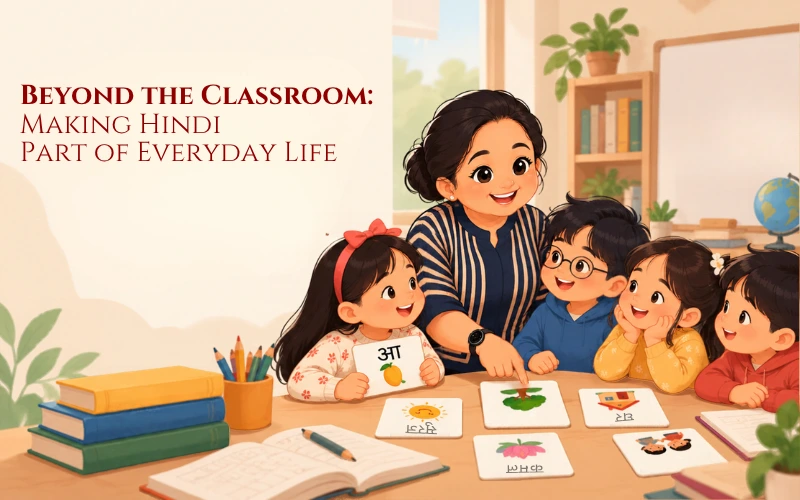
Beyond the Classroom: Making Hindi Learning for Kids a Part of Everyday Life
Youngsters don't just pick up a language by sitting down with a textbook and finishing a worksheet. They pick up new expressions in ordinary situations, participate in conversations, hear stories, and hear familiar words at home. These little events can have a significant impact on families raising children in bilingual environments.When Hindi is used in daily life rather than just in class, learning the language becomes more organic for children. Simple routines can help your child connect with family, culture, and heritage while becoming more at ease with Hindi, regardless of whether they are growing up in Hong Kong, Singapore, or another part of the world.The good news is that you don't have to dedicate hours each day or speak flawless Hindi. Your child will have more opportunities to listen, comprehend, and talk if you make a few deliberate adjustments to your family's routine.Bring Hindi into Everyday ConversationsYoungsters must be given the chance to apply the language they acquire. Incorporating Hindi into regular discussions throughout the day is one of the simplest ways to generate these possibilities.Start with brief sentences that your toddler can comprehend based on context. When making a meal, getting ready for school, or talking about the day's events, you might utilize Hindi.For example:Namaste (नमस्ते): HelloPaani (पानी): WaterKhaana (खाना): FoodChalo (चलो): Let’s goAchha (अच्छा): Good or okayDhanyavaad (धन्यवाद): Thank youSimple phrases like "Aap kaise ho" can also be introduced. "Yeh kya hai?" (What is this?), "Mujhe paani chahiye" (I want water), and "How are you?"Teaching every word at once is not the aim. During the week, pick a few phrases and use them spontaneously. Encourage your child to answer in Hindi as they get to know them, even if at first they blend Hindi with English or another language.Turn Everyday Routines into Learning OpportunitiesHindi can be introduced naturally through daily routines without making learning feel like an additional chore on a hectic schedule.Name familiar meals for breakfast. Discuss colors and attire as you're getting dressed. When cleaning up, ask your youngster to use basic Hindi instructions to identify toys or set items in their proper locations.Here are a few ways to get started:At mealtimes: Use words such as roti (रोटी), doodh (दूध), seb (सेब) and garam (गरम).While getting dressed: Practise colours such as laal (लाल), neela (नीला) and hara (हरा).During playtime: Name toys, count objects and describe what your child is doing.On the way to school: Talk about what you can see, such as a gaadi (गाड़ी), ped (पेड़) or ghar (घर).Before bedtime: Ask your child to recall one new Hindi word from the dayThese little exercises assist kids in making connections between words and actual things and experiences. They start to comprehend when and how to utilize each term rather than memorizing a list. Make Storytime a Hindi HabitChildren can be introduced to language through stories. In an interesting manner, they introduce young students to new words, well-known sentence structures, characters, and scenarios.Pick age-appropriate Hindi stories, picture books, or brief folktales. Start with stories with simple plots and clear images if your child is just starting out. Ask questions like "Yeh kaun hai?" (Who is this?) or "Billi kahaan hai?" (Where is the CT?) while pointing to the images and naming objects.Not every statement needs to be translated. Sometimes a visual, gesture, or well-known example suffices to illustrate a word.The same story can potentially be repeated over a few days. Children learn words through repetition and are better able to predict what will happen next. Ask them to finish a well-known phrase, identify a character, or recount a portion of the narrative in their own words.Indian folktales can provide an extra link to cultural customs, beliefs, and narratives that have been passed down through the ages. They offer kids an opportunity to learn Hindi while learning tales that their parents and grandparents would recognize.Use Songs, Rhymes and MovementLanguage exercise is made more engaging and remembered by music. Children can listen to and eventually start singing along to Hindi rhymes and songs, which establish sounds, rhythm, and repeated phrases.Select songs that fit your child's interests and age. Sing together as a nighttime ritual, while traveling, or during recreation. To assist your youngster in making the connection between words and meaning, incorporate hand gestures, clapping, or other basic activities.By stopping before a well-known word and asking your child to finish the line, you can make the activity more engaging. When they hear a certain word or locate an item mentioned in the song, ask them to do something.Through these exercises, kids can repeatedly hear Hindi without feeling like they're being examined. Over time, familiar sounds and expressions can become easier to recognise and use.Make Play Part of Hindi Learning for KidsChildren have an incentive to communicate through play. They have the chance to listen, ask questions, make decisions, and explain what they are doing when they are having fun.You can adapt simple games to support Hindi learning for kids at different ages and levels.Try these easy activities at home:Hindi treasure hunt: Place well-known items throughout the space and provide straightforward Hindi hints. Before teaching new words to your youngster, start with ones they already know.Picture-card matching: Match pictures with Hindi words, such as phool (फूल), kitaab (किताब) and machhli (मछली).Create a make-believe restaurant, kitchen, or store for pretend play. As they play, encourage them to name objects, practice greetings, and use simple sentences.Ask your youngster to search the house for anything that is laal (red), peela (yellow), or neela (blue).Build-a-story game: Take turns using basic Hindi words to create a character, setting, or action to a short story.Keep the exercises brief and adaptable. On certain days, your youngster might like to talk more; on other days, just listening and word recognition might be plenty. Making Hindi a language kids are at ease learning is the goal.Connect Hindi with Family and Cultural TraditionsHindi can let children feel more connected to family and cultural customs for many families that live outside of India. When kids can use language to connect with the people and situations that are important to them, language becomes more meaningful.Encourage your youngster to learn the names of family members and relationships, ask basic inquiries of relatives, and greet grandparents in Hindi. Introduce common phrases that your child can use during calls and visits if they communicate with Nana-Nani or Dada-Dadi on a regular basis.There are numerous chances to learn Hindi during festivals and family gatherings. While assisting with age-appropriate activities, children can learn the names of native foods, decorations, attire, and customs.For example, while preparing for Diwali, you could introduce words such as diya (दीया), roshni (रोशनी) and mithai (मिठाई). During a family celebration, invite your child to practise greetings or describe what they see.Children learn from these encounters that Hindi is more than just a topic for school. It's also a method to participate in family life, tell stories, and show affection.Introducing Reading and Writing at the Right PaceChildren can progressively experiment with reading and writing in Hindi but speaking and listening are crucial foundations.Start by teaching newcomers how to recognize the Devanagari script using letters, images, and well-known words. Early practice can be facilitated by short tracing exercises, matching games, and illustrated worksheets.Make sure your expectations are reasonable given your child's age and background. Before engaging in formal reading and writing practice, a youngster who is just starting to speak Hindi might want more time for vocabulary and listening exercises.Introduce brief sentences and basic words as their confidence increases. Learning in the classroom can be connected to real-world experiences by having students write a word they use at home or read a picture book they are familiar with.By teaching skills in a defined order and providing children with many opportunities to practice what they learn, a structured learning program can encourage this advancement.Encourage Progress Without Correcting Every MistakeHindi may be understood by kids before they feel comfortable speaking it. Some may stop while looking for the proper term, respond in English, or use a combination of languages. This is a typical aspect of language learning.Acknowledge your child's efforts and give them time to react. Instead of interrupting the conversation when they make a mistake, modeling the proper phrase organically.For instance, if your youngster mispronounces a phrase, repeat it correctly and carry on speaking. This provides them with a helpful example without causing them to feel awkward when speaking.Celebrate little victories, like learning a new word on your own, comprehending a question, or saying hello to a relative in Hindi. Every child's progress may be different, so instead of comparing their skills to those of other students, concentrate on developing their self-assurance and consistent involvement.Above all, maintain the association of Hindi with good experiences. When kids feel encouraged and have purposeful reasons to use the language, they are more inclined to continue practicing.Balance Home Practice with Structured Hindi ClassesAlthough daily exposure offers beneficial chances for Hindi practice, some kids also gain from directed instruction. They can improve their speaking, listening, reading, and writing abilities in a predetermined order with the aid of a systematic curriculum.Finding a program that fits the child's age, skill level, and learning requirements can help families raising bilingual children maintain regular practice.Children can study Hindi at Sanskriti through age-appropriate online courses that gradually improve language proficiency. Discussions, tales, novels, and other activities that reinforce what kids learn in class can help enhance learning at home.It is not necessary for parents to become language instructors. It is their responsibility to provide practice opportunities, demonstrate interest in the child's development, and accommodate Hindi in daily family life.Children can progress from identifying well-known terms to using Hindi more confidently with a combination of guided learning and frequent exposure.Frequently Asked QuestionsHow can I help children learn Hindi at home?Start with brief, well-known phrases that are used in everyday routines, playtime, and meals. Play easy word games, sing Hindi rhymes, and read picture books. Children can develop more at ease with the language via regular, stress-free practice.What happens if my child responds in English rather than Hindi?Give a positive response and carry on with the discussion. You can ask the child to attempt a word or phrase they are comfortable with after repeating their response in Hindi. Give youngsters time and encouragement because understanding often develops before they are ready to talk.How much time should kids spend practicing Hindi each day?No single regimen is effective for every youngster. Long practice periods may be more difficult to sustain than brief, frequent opportunities throughout the day. Activities should be tailored to your child's age, interests, and level of focus.Can kids learn Hindi if their parents don't speak it well?In addition to age-appropriate books, educational materials, and guided seminars, families can start with words and phrases that they feel comfortable using. In addition to learning with their kids, parents can concentrate on giving them constructive opportunities to hear and speak Hindi.When should kids begin learning to write and read Hindi?The child's age, level of linguistic proficiency, and preparedness all influence the ideal moment. Many kids gain from gradually being exposed to Devanagari while also improving their speaking and listening abilities. As their abilities grow, reading and writing exercises can be introduced gradually.Make Hindi Part of Your Child’s Everyday WorldIt's not necessary to start teaching kids Hindi with a lengthy lesson or a ton of worksheets. A greeting in the morning, a story before bed, a song while driving, or a chat with grandparents can all start it.Children have more opportunities to learn Hindi, try new vocabulary, and see its worth in their own lives when it is included into activities they already like.Families may help children develop Hindi skills while fostering a long-lasting bond with language, family, and culture with perseverance, purposeful practice, and the appropriate learning assistance.Discover a method that helps your child's learning process by looking through Sanskriti's online Hindi learning programs and resources.
More details
Why Hindi Rhymes Help Young Children Remember New Words
A familiar rhyme can turn an everyday moment into an opportunity to learn new words. When a new word is introduced on its own, a youngster can have trouble remembering it, but when they sing, clap, or play, they will gladly repeat it. When learning appears natural, fun, and relevant to daily life, it is simpler for young children to explore language.For families raising children in multilingual environments, Hindi rhymes can be a simple way to introduce the Hindi language at home. Rhymes provide frequent opportunities for children to listen, identify sounds, and attempt new expressions, whether they are learning their first Hindi words or growing more at ease with a language spoken by parents and grandparents.It's not only about memorising a few words. Regular exposure to well-known songs can promote a good relationship with Hindi, build vocabulary and confidence , and help kids make the connection between sounds and meaning.Why Rhythm and Repetition Help Children Remember WordsYoung children pick up language through frequent exposure. They hear words, watch how others use them, and eventually start to identify and mimic well-known expressions. This type of repetition is automatically made possible by rhymes.Children are given multiple opportunities to hear the same words without feeling like they are being taught a lesson when a line is repeated. Additionally, rhythm and melody offer a recognizable pattern that helps kids predict what will happen next.Consider a short rhyme that refers to a flower, a bird, or the sun. When a child first hears the song, they can find it enjoyable. They might recognize a word after hearing it once more. Eventually, when they hear the word, they may point to the thing or sing it on their own.Although each child learns at a different rate, regular, meaningful exposure increases the likelihood that new words will become familiar.How Hindi Rhymes Present New Hindi WordsRhymes offer language in a memorable context, which is one reason they are effective for early learning. Instead of hearing words as discrete things on a list, children hear them as part of a phrase, a song, or an action.For example, a rhyme about colours can introduce words such as लाल (laal) for red, पीला (peela) for yellow and हरा (hara) for green. Parents can point to objects around the room as these words appear in the song.A rhyme about animals might introduce बिल्ली (billi) for cat, कुत्ता (kutta) for dog or चिड़िया (chidiya) for bird. As they listen, kids can mimic animal sounds, make gestures, or point to pictures.These tiny associations assist kids in connecting a Hindi word's sound to something they can see, hear, or feel. Children begin to understand what a word means and how to use it, rather than simply memorising it. From Singing Hindi Rhymes to Speaking HindiWhile learning a word while singing is a good starting point, kids also need opportunities to utilize it outside of rhymes. By including well-known vocabulary in regular interactions, parents can gradually ease this shift.Let's say a little youngster has been singing a bird-related rhyme. After singing together, a parent can ask, “चिड़िया कहाँ है?” (Where is the bird?) while looking at a picture or watching birds outside. Before responding with a brief sentence, the youngster may first point and then utter the words "चिड़िया."The same approach works with colours, numbers, body parts, food and everyday objects. If a rhyme introduces पानी (paani), parents can use the word when giving a drink. If it refers to हाथ (haath), they can repeat it during a handwashing routine.Changing every song into a test is not the goal. Its purpose is to provide kids with an easy opportunity to hear well-known words in multiple contexts. Over time, children may begin using these words in their own conversations. Why Actions and Play Make Rhymes More MeaningfulYoung children frequently love to move just as much as they love to sing. The experience can be enhanced by clapping, tapping, pointing, dancing, and performing a rhyme.Parents can also make the connection between language and meaning via actions. Pointing to the hands, feet, or head can be used in a rhyme about body parts. Children may be encouraged to hop like rabbits or flap their arms like birds during an animal-themed song.Simple objects, toys, and pictures can improve the activity's interactivity. Parents might hold up a red ball when they hear लाल, use toy animals during a familiar song or count objects together as a rhyme progresses.You can sing while your child plays with a toy car, using “गाड़ी” (gaadi) when it comes up in the rhyme. There’s little to prepare; the toy is already there. Your child may be busy driving it under the sofa and join in for just one familiar word. Leave room for that kind of participation.How Parents Can Make Hindi Rhymes Part of Everyday LifeEstablishing an ideal learning schedule is not as important as consistency. A child's day can be made more pleasant by repeating a little rhyme at familiar times. While getting ready for breakfast, sing a rhyme and explain basic terms for foods, colours, or commonplace items.During play, pick a song that features actions, animals, or toys. Encourage your youngster to repeat, point, or motion a word that they love. Sing a well-known song while driving to school or while taking a stroll. Hindi might become a normal part of the day if you repeat something your youngster already appreciates.Before going to bed: As part of your nightly routine, pick a soft rhyme. In addition to fostering a peaceful moment together, repetition can aid in familiarising the language.It is not necessary for parents to teach a new rhyme every day. Revisiting a few favourite rhymes helps children become familiar with the words, anticipate repeated phrases and gradually join in.Choosing Rhymes That Suit Your Child's AgeIt's normal that not every child would enjoy each rhyme. Choose rhymes that suit your child’s age, interests and level of Hindi understanding. Short rhymes with repeated phrases, distinct sounds, and easy movements might serve as an effective introduction for young children. Children can connect with their environment through terminology found in songs about animals, colours, family members, and common routines. As kids get older, they could like rhymes that have longer verses, a wider vocabulary, fun noises, or short stories. Parents can ask straightforward questions about the music, ask kids to guess a line that will be repeated, or ask them to explain what they understand it to mean.Give your child time to get familiar with the rhyme. They might listen through several rounds before trying a line, or join in on the first chorus and muddle the words. Keep singing with them and let them practise at their own pace.Connecting Hindi Rhymes With Indian CultureRhymes can further foster deep ties with language, family, and cultural customs for families residing outside of India. Through music, children can learn language used in family life, hear songs that their parents or grandparents remember, or become acquainted with stories and holidays.Instead of being something that is solely found in a classroom or workbook, these mutual experiences can give the Hindi language a more intimate sense. For instance, when a grandmother teaches a childhood rhyme, they are giving a memory in addition to words and sounds.When a rhyme mentions rain, sing it by the window on a wet afternoon. Point out the Hindi word for rain, then carry on with the song. Your child may remember the tune long before every word makes sense.Explain a line when they ask. On other days, they may only want the chorus again. Sing it with them and leave the rest for another time.How Structured Hindi Learning Builds on RhymesAlthough rhymes are a good place to start, youngsters gain from learning language in a variety of ways. As kids get older, reading, writing, storytelling, picture-based activities, and conversation can all enhance listening and singing.Learning Hindi in an organised manner might help connect these experiences. Children can rehearse speaking Hindi in a safe setting, review well-known vocabulary, and learn how words fit into sentences. Activities can also be modified by a teacher to accommodate students of various ages and understanding levels.Through songs, storytelling, dialogue, and other worthwhile activities, age-appropriate Hindi instruction at Sanskriti may help kids build on what they experience at home. Families can help Hindi become more ingrained in daily life by combining regular learning opportunities with leisurely practice at home.The objective is not to measure a child's development based on how many rhymes they can recite. The goal is to gradually increase children's comprehension, allow them to express themselves, and make them feel at ease using the language.Frequently Asked Questions1. Do youngsters learn new words through Hindi rhymes?Children are repeatedly exposed to words in a memorable context through rhymes. Children are also given the chance to comprehend and utilize such words when parents relate them to images, actions, and regular discussions.2. When should kids start listening to Hindi rhymes?During the early years, families might introduce basic songs and rhymes. The child's age, interests, and reactions should be taken into consideration when selecting the rhyme, duration of the activity, and degree of engagement.3. How frequently should I sing my child Hindi rhymes?There isn't a schedule that suits every family. Rhymes can become a normal part of everyday life with brief, frequent opportunities like playtime, travel, or bedtime.4. What happens if my youngster doesn't speak Hindi but likes rhymes?Speaking and listening can grow at various speeds. As you continue to enjoy rhymes with your kid, give them gentle opportunities to utilize terms they are familiar with in conversation without pressuring them to answer.5. Do rhymes suffice for teaching Hindi?Rhymes are just one aspect of learning a language, but they can help with vocabulary, sound familiarity, and repeated expressions. Additionally, children must have meaningful opportunities to learn how to communicate, listen, comprehend, and, as they mature, acquire reading and writing skills.Small Rhymes, Meaningful LearningA familiar Hindi rhyme can be much more than a song children enjoy. It can introduce new words, encourage listening and speaking, and create happy moments of learning between parents and children.For families raising children outside India, these simple experiences can also keep language and cultural traditions connected to everyday family life. There is no need to make every rhyme a lesson. Sing together, explain a word when your child is curious, and give them the freedom to join in at their own pace.At Sanskriti, we believe that children learn best when language learning is engaging, meaningful and supported by the right guidance. Explore our online Hindi learning programmes and resources to help your child build language skills and grow more confident using Hindi.
More details
How Children Can Learn to Speak Hindi in Singapore with Confidence
Growing up in Singapore, children may hear Hindi at home but use it less often outside the home. When it's their turn to speak, they may hesitate even though they understand what their parents or grandparents say, recognise familiar Hindi vocabulary, or enjoy Hindi music and stories.In multilingual settings, this is typical. Children often switch between the languages they use at home, at school, with friends, and in the wider community. Research on multilingual development shows that the quantity and quality of exposure can influence children's skill development in each language.The good news is that it doesn't have to happen all at once. Small conversations, familiar words, stories, music, reading, and frequent chances to use Hindi in relevant contexts can all help it develop.For families looking to learn to speak Hindi in Singapore, the goal should not simply be to make children memorise more words. It should be to help them feel comfortable using the language.Confidence Comes Before Perfect HindiWhen a child understands Hindi but responds in English, many parents become concerned. Others see that while their child is proficient in single words, they fall silent when asked to construct a sentence.This does not necessarily mean the child is not learning. Speaking and understanding frequently develop differently, and multilingual kids may have distinct talents in speaking, listening, reading, and writing. Additionally, studies show that children who grow up speaking a heritage language may be exposed to the dominant community language much more as they get older.Rather than fixing every little error, parents may make Hindi feel practical and pleasurable.A child may be ready for a lengthy conversation tomorrow if they feel comfortable speaking a basic sentence now.Start With Hindi Words Children Can Actually UseWhen kids can use their vocabulary right away, it becomes much more meaningful.Start with words relevant to the child's daily life rather than introducing lengthy vocabulary lists.For instance:पानी (paani) – waterखाना (khaana) – foodघर (ghar) – homeकिताब (kitaab) – bookमाँ (maa) – motherपापा (papa) – fatherखेलना (khelna) – to playआओ (aao) – comeचलो (chalo) – let's goधन्यवाद (dhanyavaad) – thank youBut when these words are used in a discussion, that's when the true learning starts.Instead of teaching only पानी, parents can ask, “तुम्हें पानी चाहिए?” and encourage the child to answer, “हाँ, मुझे पानी चाहिए।”The toddler is no longer just recalling Hindi words. They're learning how to use those words in real conversation.Turn Hindi Words Into Little ConversationsWhen kids realise they already know enough Hindi to communicate, their confidence improves.A routine can develop into a dialogue:Parent: आज स्कूल कैसा था?Child: अच्छा था।Parent: आज क्या किया?Child: मैंने खेला।It doesn't have to be a lengthy chat. Repeated opportunities for the youngster to listen, react, and expand on their prior knowledge are crucial.Conversations can progressively become more sophisticated as language expands.A child who begins with “अच्छा” may eventually say, “आज स्कूल में मैंने अपने दोस्तों के साथ खेला।”Memorising a long list of words without using them is far less beneficial than that progress.Make Speaking Hindi Part of Everyday LifeEvery Hindi conversation does not have to feel like a lecture to kids.Family life already offers some of the most natural opportunities.Try speaking Hindi when:Mealtimes:Find out what the youngster wants to eat or drink.Getting ready:Use simple instructions such as “जूते पहनो” or “चलो, जल्दी करो।”Traveling:Identify objects around you and say their Hindi names.Purchasing:Ask kids to recognise numbers, colours, fruits, and vegetables in Hindi.Calls from family:Give kids the opportunity to converse in Hindi with grandparents or other family members.Time for bed:Talk about the child's day or read a little Hindi story.Instead of something that only happens in class, these small moments make Hindi part of everyday life.Stories Can Give Children Something to Talk AboutWhen kids have something important to say, speaking gets easier.That's exactly what a Hindi narrative can offer.Parents can pose straightforward queries following the reading of a story:“कहानी में कौन था?”“उसे क्या मिला?”“तुम्हें कहानी कैसी लगी?”Kids can start with single words and work their way up to full sentences.Children also learn vocabulary in context through stories. They hear how a word functions in a sentence and understand it through the surrounding narrative rather than as an isolated definition.In multilingual households, shared reading might be very helpful. Although findings vary by language, family, and setting, research on bilingual children has linked aspects of language development to home reading and language engagement.Songs, Games and Movement Make Speaking Less IntimidatingA child may gladly participate in a game or song but be reluctant to answer a question directly.For this reason, playful activities can be especially beneficial for learning a language.Try:Action songs in HindiGames that rhymeVocabulary games with picturesGames of guessworkBingo in HindiSequencing of storiesAct out discussionsSimple role-playing, such as placing a restaurant order or going shoppingWithout making the exercise feel like a speaking exam, it provides kids a reason to talk.This can be especially helpful for kids who are afraid of making mistakes.Why Structured Learning Can HelpAlthough home exposure is crucial, families may struggle to build consistent progress on their own.This is where disciplined Hindi learning can help.Formal learning paths and community-based Hindi programs already promote Hindi education in Singapore. For instance, Singaporean schools make arrangements for pupils to study Hindi as a non-Tamil Indian language under certain conditions, and the Hindi Society Singapore offers Hindi instruction from pre-primary to junior college.Children can practise regularly through a planned programme.Paying attention and comprehendingEveryday conversation Hindi vocabularySentence constructionReading Devanagari Stories, songs and cultural activities Making every child speak in the same manner or develop at precisely the same rate shouldn't be the goal. The goal should be to give each youngster a clear path from what they already know to what they can use with confidence.Let Children Make MistakesThe fear of making a mistake can be one of the biggest obstacles to speaking.Even if a child knows the answer, they may stay quiet for fear of their grammar, pronunciation, or getting reprimanded.Parents can assist by first addressing the meaning.Instead of making the error the centre of the conversation, softly mimic the correct version when a child says something poorly.For instance, if a young child says:“मैं पानी चाहती”A parent can react instinctively:“हाँ, तुम्हें पानी चाहिए।”The child hears the proper structure without feeling that their effort was in vain.When kids understand that making errors is a natural part of learning, their confidence grows.Give Children a Reason to Speak Hindi"You need to learn Hindi" is frequently not the strongest drive.There's a good reason to use it.A child might wish to discuss school with a grandmother. They might wish to comprehend a story in Hindi. Maybe they want to sing along to a song, order something, play a game, or discuss their favourite sport.Research on heritage-language development suggests that children's language proficiency can be influenced by the people they interact with and the amount of heritage-language information they receive.So rather than asking only, “How can we teach more Hindi?”, families can also ask:“Where can my child use Hindi today?”Learning a language might feel much more worthwhile with that tiny shift in perspective.Learning Hindi in Singapore Can Be Part of Growing Up MultilingualChildren in Singapore may switch between multiple languages during the course of a typical week because the country is naturally bilingual.A child learning Hindi does not need to choose between Hindi and other languages.They can continue to develop Hindi as a significant family and heritage language while speaking English with friends and using another language in their community or at school.The Singapore-Cambridge Hindi curriculum emphasises meaningful conversation, reading, expressing thoughts and emotions, and cultivating cultural awareness.Therefore, gathering additional Hindi words is not the only goal.The goal is to help kids develop the ability to use those terms on their own.From Hindi Words to Confident ConversationsEven after learning hundreds of words by heart, a youngster does not develop into a confident Hindi speaker.Use is the foundation of confidence.A sentence is formed from a new word. A phrase turns into a query. A query turns into a dialogue. Over time, those discussions become part of how a child interacts with others.For families who want to learn to speak Hindi in Singapore, the journey can begin with something very small: one word, one story, one song or one everyday conversation.With consistent exposure, patient encouragement, and meaningful speaking chances, Hindi can progress from something a child understands to something they feel comfortable using.Frequently Asked QuestionsHow can I help my child become confident when speaking Hindi?Give your kids frequent chances to hear and speak Hindi in relevant contexts. This process can be aided by regular chats, stories, music, games, family interactions, and organised classes.What happens if my child doesn't speak Hindi but can understand it?Bilingual kids frequently experience this. Speaking and understanding may develop at different speeds. Keep giving the youngster chances to respond in Hindi without putting undue pressure on them.How many words in Hindi should a youngster learn at first?There isn't a single figure that suits every child. Start by teaching kids practical vocabulary for daily life, then help them use those words in short sentences and dialogues.Can kids who speak English as their primary language learn Hindi?Indeed. With consistent exposure and purposeful opportunity to utilise it, children can acquire a heritage language. Creating Hindi-speaking moments at home can help because the quantity and quality of interaction matter.Are Hindi studies beneficial for Singaporean kids?Structured classes offer regular progress and chances to practise speaking, listening, reading, and writing. Community organisations and schools in Singapore have developed Hindi education channels.ConclusionGetting every sentence straight from the start is not the goal of learning to speak Hindi confidently.Giving kids enough chances to listen, react, try new things, and try again is the key.A song on the drive, a talk with grandparents, a story before bed, a few Hindi words at breakfast, and a typical lesson can all become a part of the same journey.For children growing up in Singapore, Hindi can be more than a language they study. With the right support, it can become a language they use, enjoy and feel confident speaking.
More details
Tongue Twisters in Hindi: Making Hindi Practice Fun Through Words, Stories and Books
It's not always necessary to start learning a language with worksheets or memorisation of vocabulary. Sometimes it starts with a word that a child likes to say out loud, a story they want to hear again, or a humorous phrase that makes them laugh. Tongue twisters in Hindi bring all three of these experiences together. They give kids the chance to listen intently, repeat Hindi phrases, and grow more at ease with the language while turning sounds and words into a fun activity.These brief moments of playful practice can be especially beneficial for kids learning Hindi as a second or extra language. In a way that doesn't feel like formal study, a tongue twister can introduce new sounds, intriguing vocabulary, and rhythm. Children can learn Hindi in a variety of ways rather than depending solely on one kind of activity when this is paired with stories, Hindi books, flashcards, songs, and casual conversation.What Makes Tongue Twisters So Much Fun for Kids?A tongue twister's appeal is straightforward: it's funny, challenging, and satisfying to repeat. Youngsters frequently take pleasure in attempting to pronounce a difficult phrase correctly, particularly when they can challenge their parents, siblings, or peers to try.However, speed need not be the objective. It is more beneficial for younger students to concentrate on speaking the words clearly and listening intently. A parent or instructor can say the phrase slowly at first, allow the child to repeat it, and then progressively add a little more rhythm.Tongue twisters are therefore a versatile activity for a range of ages and Hindi proficiency levels. While a more confident learner can attempt longer and more difficult phrases, a beginner might only work with a few well-known words.Tongue Twisters Can Help Kids:Ask your child to listen once before speaking. They can pick out the Hindi sounds that feel unfamiliar.On the second try, let them say the line aloud and find its beat.Children often remember a new word when they hear it inside a silly sentence.Take turns with siblings or parents. Each person can repeat the same line at a different speed.After three or four attempts, a child who whispered at first may volunteer to go first.Expect mixed-up words and plenty of laughter. Pause at the difficult part, say it together and try once more.Praise each attempt and leave perfect pronunciation for another day.It's crucial to keep the experience lighthearted. Instead of worrying about correctly pronouncing every word on their first try, children should be encouraged to experiment with the language.Fun Tongue Twisters in Hindi for Kids to TryOnce children understand how tongue twisters work, it can be fun to try a few together. Parents can start with shorter phrases and gradually introduce longer ones as children become more comfortable. The goal is not to say them as quickly as possible, but to listen carefully, enjoy the rhythm and have fun with the words.1. कच्चा पापड़, पक्का पापड़Pronunciation: Kaccha papad, pakka papadMeaning: Raw papad, crisp papad.2. चंदू के चाचा ने, चंदू की चाची को, चांदनी चौक में, चांदी के चम्मच से चटनी चटाईPronunciation: Chandu ke chacha ne, Chandu ki chachi ko, Chandni Chowk mein, chandi ke chammach se chatni chatayiMeaning: Chandu’s uncle fed chutney to Chandu’s aunt with a silver spoon in bustling Chandni Chowk.3. खड़क सिंह के खड़कने से खड़कती हैं खिड़कियां, खिड़कियों के खड़कने से खड़कता है खड़क सिंहPronunciation: Khadak Singh ke khadakne se khadakti hain khidkiyan, khidkiyon ke khadakne se khadakta hai Khadak SinghMeaning: When Khadak Singh shakes, the windows shake, and when the windows shake, Khadak Singh shakes right back.4. समझ समझ के समझ को समझो, समझ समझना भी एक समझ हैPronunciation: Samajh samajh ke samajh ko samjho, samajh samajhna bhi ek samajh haiMeaning: Use your understanding to understand understanding, because understanding understanding is also an understanding.5. पीतल के पतीले में पपीता पीला-पीलाPronunciation: Peetal ke patile mein papita peela-peelaMeaning: A bright yellow papaya sitting in a brass pot.These tongue twisters can be practised slowly at first, with children listening to each sound before repeating the phrase. Parents can also choose one or two unfamiliar words from a tongue twister and use them for a simple vocabulary activity. This makes the exercise more than just a speaking challenge and gives children another opportunity to explore Hindi.Tongue Twisters in Hindi Can Become Much More Than a Word GameMore Than a Word Game When kids grasp the words they are saying, a tongue twister takes on a much deeper significance. Parents and educators can use it as a conversation starter rather than as a phrase to commit to memory.If a child comes across a new Hindi word, ask what they think it means. Encourage them to use it in a short sentence after explaining it with a well-known example. Make a connection between the word and a picture, a story, or an experience the child has had if it describes an animal, an object, or an action.This establishes a straightforward learning process:Hear the word → Understand the word → Say the word → Use the wordThis method can help kids go beyond just repeating Hindi and start using it with more comprehension.Including Stories in Hindi PracticeStories give kids context, which is something that isolated words can't always offer. Children can comprehend how a new word fits into a sentence and how it relates to the characters or events they are following when they hear it in a story.Here, books in Hindi can be a logical progression of tongue-twister exercises. Parents can select a Hindi story with well-known vocabulary after practicing a few words. As the narrative progresses, kids can listen for those words and indicate when they hear them.Additionally, reading aloud can become interactive. Children can use basic Hindi to describe what they see, and parents can ask questions about the images, characters, and events.For example, after reading a short story, you could ask:कौन है?यह क्या है?कहानी में क्या हुआ?तुम्हें कौन सा पात्र पसंद आया?यह कौन सा रंग है?The questions do not need to be complicated. Even short exchanges can give children an opportunity to hear and use Hindi naturally.How Hindi Books Can Help with Language LearningRegular exposure to a language can strengthen a child's bond with it. Children can learn Hindi outside of a formal classroom by having age-appropriate Hindi books at home.In addition to encouraging kids to look at Devanagari and make connections between written words and their meanings, a book can introduce vocabulary, expressions, characters, cultural settings, and stories.Young children often make their own route through a picture book. They may skip three pages, then spend five minutes staring at one drawing. Name whatever has caught your child’s eye in Hindi and see what they do with the word. An older child might read a line alone or tell you why a character made a bad choice.Some evenings, skip the questions and enjoy the book. Stop when your child has had enough. If they bring it back tomorrow, read it again.Use Flash Cards to Make Learning More InteractiveFlash cards can add another fun component to the learning process. They enable quick connections between words and images, which is especially helpful when kids are starting to expand their vocabulary.A teacher or parent can ask the child to repeat a Hindi word after displaying a picture. The child can then be asked to find the same word in a book or use it in a sentence to extend the activity.Additionally, flashcards can be used to create straightforward games like picture and word matching, which involve:1. Picture and word matching: Matching a Hindi word to the appropriate picture.2. Find the word: Ask kids to locate a specific word by hiding a few cards.3. Story building: Select three cards and use them to tell a short story.4. Guess the word: Let the child identify the card after providing Hindi clues.5. Tongue twister connection: Create amusing phrases by selecting words from the cards.This keeps repetition from feeling monotonous while enabling kids to review vocabulary.From Tongue Twisters to Books: Creating a Complete Hindi ActivityCombining various activities rather than depending solely on one exercise is one of the simplest ways to make Hindi practice interesting.This is how a quick session might go:Begin with a tongue twisterIntroduce a lighthearted Hindi phrase and practice pronouncing it slowly.Investigate the vocabularyDescribe the definitions of two or three unfamiliar words.Make use of flashcardsLet the child identify the pictures that are associated with those words.Go through a Hindi bookIn a short story, look for some of the well-known terms.Discuss the narrativeEncourage the child to answer in Hindi by posing straightforward questions.Finish with a gameUse one of the new words to make a humorous sentence or repeat the tongue twister.This type of sequence keeps the activity engaging and varied while giving kids multiple opportunities to interact with the same language.Where UDAAN Comes InIntroducing Hindi is important for very young learners. Toddlers learn through play, movement, repetition, sounds, and interaction. They are inherently curious. This is the philosophy underlying Sanskriti's Hindi Playgroup for Infants and Toddlers, or UDAAN.With songs, rhymes, stories, colors, movement, and activities, UDAAN brings Hindi into a playful setting for kids ages 12 to 36 months. The program gives toddlers the chance to hear and experience Hindi through age-appropriate activities instead of expecting them to sit through a traditional language lesson.The approach also brings together learning materials that children can continue exploring beyond the session. The Sanskriti Kit includes:Flash cardsHindi vocabulary builderTracing bookCraft bookSanskriti bagThese materials provide kids with various ways to engage with Hindi. A word can be introduced using a flash card, given context through a story, or used in a craft project.Including Hindi in Everyday Family LifeTo facilitate Hindi learning, parents do not have to set up a formal classroom at home. Meaningful opportunities to use the language can be found in small moments throughout the day.You could:At breakfast, name two things on the table in Hindi.Keep a short Hindi story beside the bed and let your child choose how much to read.Use two or three flash cards while waiting for dinner.Sing the same Hindi rhyme while your child gets dressed.Pick one picture and ask, “What do you see?”Let grandparents lead a short Hindi chat. If the conversation slows, try a family tongue twister.Choose one new Hindi word on Monday and keep using it during the week.Choose whichever activity fits the day. Five minutes at breakfast still counts. Return to the same word tomorrow and give your child time to recognise it.Why Play Can Change How Children Experience HindiA child who trips over a tongue twister may ask for another turn, especially when a parent gets it wrong too. Everyone laughs, and the child repeats the same Hindi sounds several times.If one of those words appears in a story later, point it out. Your child may remember the funny tongue twister before remembering the meaning. Talk about the word there, while the moment is fresh.A playful sound could be introduced with a tongue twister. A new word could be introduced using a flash card. That word might have a story in a book. The child might be motivated to use it by a conversation.Every encounter adds a new layer.For families raising children outside of India, where Hindi might not be the language that kids hear most frequently during the day, this is particularly significant. Maintaining the language's presence in daily family life can be achieved by providing frequent opportunities to engage with Hindi through play, stories, songs, and books.Frequently Asked QuestionsWhat are tongue twisters in Hindi?Tongue twisters are sentences or phrases that have difficult sound combinations or repetitions. They are frequently employed as lighthearted speaking exercises that can motivate kids to pay close attention and practice pronouncing Hindi words.Are tongue twisters suitable for young children?Younger kids can begin with brief, basic sentences and concentrate on repeating them slowly. Instead of concentrating on speaking quickly, the activity should be enjoyable.How can parents make tongue twisters more interesting?Parents can use them in conjunction with simple games, stories, songs, flash cards, and pictures. Using well-known Hindi words, kids can alternately construct humorous sentences with their parents or siblings.Is it possible for children to learn new vocabulary through Hindi books?Children can come across Hindi words in stories and illustrations through books. Children can be encouraged to ask questions, describe what they see, and use words they are familiar with in conversation by reading aloud to each other.How can flash cards be used for learning Hindi?They can be used to introduce and review vocabulary using words and pictures. Parents can use them as simple speaking exercises, storytelling activities, matching games, or guessing games.What is UDAAN by Sanskriti?UDAAN is Sanskriti's Hindi Playgroup for infants and toddlers aged 12 to 36 months. It introduces Hindi through songs, rhymes, stories, play, movement and age appropriate activities, supported by a Sanskriti Kit containing learning resources such as flash cards, a vocabulary builder, tracing book and craft book.ConclusionLearning Hindi can begin with something as simple as a playful phrase. Tongue twisters in Hindi give children a reason to listen, repeat and experiment with words, but their value becomes even greater when they are connected with stories, books, flash cards, songs and conversation.Creating lengthy study sessions is not the only objective for parents. A quick tongue twister, a few minutes spent reading a Hindi book, or a straightforward flash card game can all contribute to a child's daily interaction with the language.This concept is realized in Sanskriti through materials and educational opportunities that inspire kids to engage with Hindi in various contexts. The goal is to make Hindi something that kids can hear, explore, speak, and enjoy through everything from books and flash cards to entertaining programs like UDAAN.Because sometimes giving a child a reason to enjoy playing with the language's words is the best way to help them learn it.
More details
Hindi Learning for Kids: Building a Global Network Through Language and Friendship
IntroductionLearning a language can open the door to something much bigger than vocabulary and grammar. For children, it can create opportunities to communicate, share experiences, discover culture, and build friendships.For families living outside India, Hindi learning for kids can sometimes happen mainly at home or in a classroom. But children also need opportunities to use the language naturally with people their own age. When they meet other children who are learning or speaking Hindi, the language can become something they experience together rather than something they simply study.This is where the idea of a global Hindi network becomes meaningful.A child in Singapore can learn Hindi alongside another child whose family lives in Hong Kong, India, the United Kingdom, Australia, or elsewhere in the world. They may have different lives and backgrounds, but Hindi can give them a shared way to connect.Why Children Need Opportunities to Use Hindi with Other ChildrenChildren learn languages through repeated exposure and meaningful interaction. Hearing Hindi from parents, grandparents, teachers, stories, and videos is valuable, but using the language with other children can create a different kind of motivation.A child may be more excited to say a new Hindi word when they can use it while talking about their favourite game, telling a story, or sharing an experience with a friend.Friendships can make language feel practical.Instead of thinking, “I have to learn this word,” children begin to think, “I can use this word to talk to someone.”That small shift can make learning feel more natural.Language Can Create a Sense of BelongingFor children growing up in multilingual environments, identity can be shaped by many languages and cultures. English may be the language they use at school, while another language may be spoken with friends or in the wider community.Hindi can become another important part of that world.When children meet others who understand Hindi, they may discover that the language they hear at home is also spoken by children elsewhere. A word used by a parent or grandparent can suddenly become something they share with a friend.This can help children see Hindi not simply as a heritage language, but as a living language that connects people.Hindi Learning for Kids in SingaporeSingapore offers an interesting environment for children learning Hindi. The country is known for its multilingual and multicultural environment, giving families opportunities to explore different languages, traditions, and cultural experiences.For families looking for structured learning opportunities, Hindi classes in Singapore can provide children with a regular space to hear, practise, and use Hindi. Group learning can also introduce children to other young learners who may have similar experiences of growing up with multiple languages and cultures.Language learning can become even more meaningful when children are able to participate in activities together. Stories, music, drama, art, games, and cultural celebrations can give children opportunities to use Hindi while interacting with their peers.How Hindi Classes in Singapore Can Become a CommunityA Hindi class in Singapore can be more than a weekly lesson.It can become a place where children recognise familiar faces, share stories, celebrate festivals, work on activities together, and gradually become comfortable using Hindi around their peers.This social element can be particularly helpful for children who understand Hindi but hesitate to speak it.When they hear another child using the same language, speaking Hindi can feel less unusual and more natural.Classroom activities can encourage this through:Pair conversationsStorytellingRole playGroup gamesCultural projectsHindi songs and poemsFestival activitiesShow and tellThe language becomes part of an experience rather than a separate academic task.Building Connections Beyond the ClassroomA child's Hindi community does not have to be limited to one neighborhood or school.Digital learning has made it possible for children to encounter Hindi speakers and learners from different parts of the world. Online classes, storytelling sessions, cultural activities, educational videos, and virtual events can give children additional opportunities to hear and use Hindi.For families living outside India, this can be especially meaningful.A child may not have many Hindi-speaking friends at school, but they may discover other children who share similar experiences through Hindi learning programmes and communities.This creates a wider network where children can learn from one another while discovering that their experiences are shared by families around the world.The Role of the Indian Community in SingaporeThe Indian community in Singapore is diverse, with families connected to different Indian languages, regions, traditions, and cultural backgrounds.That diversity is important to recognise. Being part of the Indian community does not automatically mean speaking Hindi, and children can have strong connections to many Indian languages.At the same time, Hindi can provide an additional bridge for families who use it at home or want their children to develop it as a heritage or additional language.Community events, cultural celebrations, storytelling, music, and language programmes can give children opportunities to experience this connection outside formal lessons.The more children encounter language in meaningful social settings, the more naturally it can become part of their lives.Helping Your Child Build Hindi-Speaking FriendshipsParents do not need to organise a large community to help children find language connections. Small steps can make a difference.Look for Shared Learning OpportunitiesExplore age-appropriate Hindi classes, workshops, cultural programmes, or group activities where children can meet other Hindi learners.Encourage Group ActivitiesStorytelling, drama, games, art, and music can make it easier for children to interact without feeling that every conversation is a language exercise.Connect With Other FamiliesIf your child enjoys Hindi classes, consider building connections with other parents and families from the same learning community.Simple playdates or group activities can give children another opportunity to use Hindi naturally.Make Festivals SocialBefore Diwali, invite a cousin or friend to make greeting cards with your child. As they draw diyas and choose colours, name the objects on the table in Hindi: लाल (laal) for red, पीला (peela) for yellow and दीया (diya) for lamp. Ask them to write a short Hindi greeting inside each card. Soon, one child may ask for the लाल crayon while the other checks how to spell the greeting. Both practise Hindi as they work together.Use Digital Communities ThoughtfullyYour child might join a weekly video call to read a Hindi story with children who live in other cities or countries. Before signing up, check who leads the group, who admits participants and whether children can send private messages. Join your child for the first few sessions so you can see how the host runs the activity and how your child responds.From Learning Hindi to Living HindiOne of the most valuable changes happens when children stop seeing Hindi only as something they need to learn and begin seeing it as something they can live with.They can use it to greet a friend.They can tell jokes.They can describe a drawing.They can talk about a festival.They can share a story with someone who understands.These moments give language an emotional purpose.A child may forget a vocabulary list, but they are more likely to remember the feeling of being understood by someone who speaks the same language.How Parents Can Keep the Connection GrowingBuilding a Hindi-speaking environment does not require Hindi to be spoken every minute of the day.Small, consistent habits can help.Parents can:Choose one regular time each week for a Hindi conversation.At bedtime, take turns reading a short Hindi story aloud.Ask your child to tell a grandparent about their day in Hindi.Watch a Hindi educational video together, then discuss one part of it.Look for a small group Hindi activity designed for your child’s age.During festival preparations, use Hindi words for the food, decorations and customs around you.Help your child stay in touch with friends who are learning Hindi.When your child makes a mistake, let them finish speaking. Praise the effort before correcting the word.The aim is to create positive associations with Hindi.When children connect the language with family, friendship, laughter, creativity, and shared experiences, they have more reasons to continue using it.Sanskriti and the Idea of a Global Hindi NetworkAt Sanskriti, we believe Hindi learning can be about more than learning words and sentences. It can be a way for children to stay connected to language, culture, and one another.A global Hindi network can bring together children who may live thousands of kilometres apart but share an interest in the language.Through Hindi classes, learning activities, stories, cultural experiences, and digital resources, children can discover that they are part of something larger than their individual classroom.For a child growing up in Singapore, Hong Kong, or another part of the world, this sense of connection can make Hindi feel more relevant to everyday life.Frequently Asked QuestionsWhy is Hindi learning for kids more meaningful when children learn together?Learning with other children gives young learners opportunities to use Hindi for real communication. Speaking with peers can make language practice more enjoyable and help children become more comfortable expressing themselves.Are Hindi classes in Singapore useful for children growing up bilingual?Yes. Structured Hindi classes can provide regular opportunities to practise listening, speaking, reading, and writing. Group activities can also give children opportunities to interact with other learners.How can children connect with other Hindi-speaking children?Families can explore Hindi classes, cultural programmes, group activities, storytelling sessions, and supervise online learning opportunities where children can meet other Hindi learners.Does being part of the Indian community in Singapore mean a child needs to learn Hindi?Not necessarily. Singapore's Indian community includes people with many different linguistic and cultural backgrounds. Hindi can be an important heritage or additional language for some families, while others may connect more strongly with different Indian languages.How can parents make Hindi feel more natural?Give children opportunities to use Hindi beyond formal lessons. Conversations, stories, games, festivals, friendships, and everyday family interactions can all help.ConclusionLanguage becomes more meaningful when children have people to share it with.For children growing up outside India, Hindi learning for kids can provide more than vocabulary, reading, or speaking skills. It can create opportunities to connect with family, understand culture, and build friendships with children who share an interest in the language.Whether through Hindi classes in Singapore, cultural activities, family conversations, or digital learning communities, every interaction can help children see Hindi as a living part of their world.A global Hindi network does not have to begin with thousands of children. It can begin with two children discovering that they have a language in common.And from that connection, a lifelong relationship with Hindi can grow.
More details
Communication Skills in the AI Age: How Learning Hindi Prepares Children for the Future
IntroductionArtificial intelligence is revolutionizing education, employment, and communication. Technology has permeated every aspect of daily life, from chatbots and AI-powered writing tools to virtual assistants and rapid translations. Many parents naturally worry about what talents will be important in the future as their children grow up in this world that is changing so quickly.While technical knowledge will continue to be important, experts increasingly agree that unique human abilities such as creativity, empathy, collaboration, and communication skills will become even more valuable. AI is capable of processing data and producing answers, but it cannot take the place of meaningful conversations, true human connection, or cultural understanding.This is where language learning takes on a new significance. The benefits of multilingualism extend far beyond speaking multiple languages. Youngsters who study multiple languages as they grow up frequently have better communication skills, more cognitive flexibility, and a broader understanding of other cultures. In a world that is growing more interconnected, these attributes are becoming crucial.For families who choose to learn Hindi online, learning grammar and vocabulary is just one part of the journey. It is a chance to help kids keep connected to their heritage, speak with family members with confidence, and acquire skills that technology cannot replace while preparing them for the future.Why Communication Skills Matter More Than EverThe importance of human contact is increasing rather than decreasing as AI continues to automate repetitive jobs.People who can work with different teams, solve issues creatively, communicate ideas clearly, and form deep connections will be needed in the workplace of the future. AI can help with email writing and text translation, but it cannot fully comprehend emotions, decipher cultural quirks, or foster trust the way people can. Strong communication skills help children:Confidently voice their opinionsEngage in active listening and comprehend other viewpointsEffectively cooperate with othersCreate deep connectionsHandle disagreements with respect and sensitivityLong before kids start working, these skills start to develop. They develop communication skills that will help them throughout their lives through everyday chats at home, storytelling, class discussions, and interactions with family.Investing in language development now allows parents to prepare their kids for opportunities that go well beyond the classroom. The Benefits of Multilingualism in an AI-Driven WorldChildren who learn multiple languages benefit in ways that go far beyond simple communication. Research shows that multilingual children often develop stronger executive functioning skills, including attention, memory, and mental flexibility. They frequently move between languages, which helps the brain organize information, adapt, and think from many angles.The benefits of multilingualism are especially valuable in a world where adaptability is becoming one of the most important future-ready skills.Multilingual kids frequently benefit from:Increased adaptability of the mindEnhanced capacity for solving problemsA greater understanding of cultureImproved ability to listenSelf-assurance when interacting with individuals from diverse backgroundsThese qualities enhance the technical abilities kids will acquire during their schooling. The capacity to interact in multiple languages and comprehend other cultures is becoming more and more important as workplaces grow more global.Instead of competing with AI, multilingual kids acquire traits that are difficult for technology to imitate.Why Hindi Is More Than Just Another LanguageHindi is considerably more than just a language for many families that live outside of India. It contains cultural beliefs, customs, tales, and family recollections that are frequently passed down from one generation to the next.Learning Hindi is more than just picking up a new language. Children develop closer bonds with their grandparents, learning about family customs, and having access to original works of literature, music, festivals, and cultural events.Confidence and identity are also strengthened by this closer bond. Youngsters who are aware of their heritage frequently grow to value diversity more and feel at ease accepting both their cultural heritage and the larger global community.This balance between cultural identification and global knowledge is becoming more and more crucial in today's interconnected society.How Learning Hindi Builds Future-Ready SkillsSince English is now the primary language of business and school, many parents question if studying a heritage language is still desirable. The answer is increasingly yes in today's AI-powered world, not because Hindi takes the role of English, but rather because it helps kids acquire skills that enhance their general education.Vocabulary is only one aspect of language. Children are encouraged to organise their thoughts, select acceptable words, comprehend context, and reply carefully in every conversation. These encounters improve communication skills, which are useful in the classroom and later in one's career.Children who learn Hindi are also exposed to many modes of expression. It is not always possible to translate the meanings of many terms, proverbs, and cultural expressions into another language. Children gain more empathy, curiosity, and respect for diverse viewpoints when they comprehend these subtleties.Children who are multilingual find that moving between languages is a natural way to practice flexible thinking. In a world where individuals collaborate across cultures and nations, the capacity to adapt, comprehend context, and communicate effectively is becoming more and more important.Learning Hindi Online: Making Language Learning AccessibleParents who choose to learn Hindi online can access structured lessons, interactive activities, digital books, and experienced teachers from anywhere in the world. Children may balance school, extracurricular activities, and home life while learning at their own pace because of this flexibility.Consistent practice is another benefit of online learning. Children are more motivated by brief, interesting lectures than by sporadic, intense study sessions.To ensure the success of online Hindi education, parents can:Encourage consistent practice by teaching brief lessons every day.Give people the chance to speak Hindi in casual conversations.Together, read Hindi stories that are suitable for your age.Celebrate Indian holidays and teach terminology that is relevant.Use games, music, and artistic endeavours to enhance learning.Perfection is not the aim. Children are gaining self-assurance and enjoying the use of the language in relevant contexts thanks to it.Preparing Children for Tomorrow Starts TodayThose who are able to blend great human skills with technical understanding will own the future. Employers will place a higher priority on those who can think critically, cooperate well, communicate clearly, and comprehend other viewpoints, even as AI continues to change industries.It is not necessary for parents to choose between protecting their cultural legacy and preparing their kids for the digital age. Together, they can both develop.Children who learn Hindi in addition to other languages develop communication skills outside of the classroom. They develop better bonds with their families and communities, learn to express themselves with confidence, and gain an appreciation for diverse cultures.Through these encounters, kids develop into flexible learners who feel at ease in both local and global settings.Frequently Asked QuestionsIn the era of artificial intelligence, why are communication skills crucial?As AI takes over routine tasks, employers place greater value on people who communicate clearly, work well with others, understand different perspectives and think through difficult problems. Workers use these skills to resolve disagreements, earn their colleagues’ trust and make sound decisions as a team.What advantages can multilingualism offer kids?Stronger communication skills, increased cognitive flexibility, enhanced cultural awareness, improved listening skills, and greater confidence when interacting with people from diverse backgrounds are all advantages of being multilingual.Can kids benefit from studying Hindi later on?Indeed. Children who learn Hindi are better able to communicate, connect with their cultural history, and acquire multilingual skills, all of which are beneficial in the interconnected world of today.Is it feasible to successfully learn Hindi online?Of course. Families can learn Hindi online with guided learning programs, books, interactive exercises, and structured lessons that make language learning interesting and available from any location.Do kids get confused when they learn many languages?According to research, youngsters who are consistently exposed to and given meaningful opportunities to utilize various languages are completely capable of learning them. Rather than impeding cognitive and communication development, multilingualism frequently promotes it.ConclusionPeople now use AI to find information, finish tasks and communicate. Human judgement still shapes how we listen, understand another person’s point of view and respond with care. Those qualities help us build trust and form genuine relationships.Developing strong communication skills is one of the best ways parents can prepare children for the future. Alongside these skills, the benefits of multilingualism provide children with greater adaptability, cultural awareness, and confidence in an increasingly global world.Choosing to learn Hindi online is about more than adding another language to a child's education. It is about assisting them in creating deep connections, maintaining ties to their culture, and acquiring future-ready abilities that technology cannot replace.Children who are raised in multilingual and multicultural environments are not only better equipped for the workforce of the future, but they are also better equipped to be considerate, self-assured, and caring global citizens.
More details
The Sanskriti Calendar 2026 Is Out! The Stories That Shape Our Childhood.
We at Sanskriti celebrate culture the way it ought to be celebrated - with imagination, stories, and creativity. The Sanskriti Calendar 2026 is a creative expression of how children view iconic Indian book characters through their eyes. The calendar is a celebration of Indian heritage and is a bridge to those book characters and stories that have woven generations.The Sanskriti Global Drawing Competition theme for this year, "Book Characters of India," encouraged kids from Hong Kong, Singapore, Dubai, Vancouver, Seattle, and India to venture into the world of fantasy of Indian books and comics. From mythological personalities such as Akbar and Birbal to current comic characters such as Tenali Raman, Motu Patlu, Pinki, and Chacha Chaudhury, the kids chose their favorite characters. These figures are informative and creative and assist the children in connecting to their heritage.From 65 beautiful submissions, 12 drawings were chosen to cover each month of the calendar, and 4 won a special mention. Each of the drawings is not just a drawing; it's a memory, it's a story, it's a symbol of pride of culture. Seeing the children's creativity on every page brought a treasure of joy, knowing that this calendar is not just an educational resource but also a bridge between cultures.Behind the Art: Children Speak About Their InspirationThe beauty of the Sanskriti Calendar 2026 is that the tales feed the paintings. Every one of the children brought his or her favorite character to life, not merely through colors and strokes but through ideas, imagination, and a pride of belonging to where he or she was. Every painting tells a tale, and hearing that from the children themselves is a testament to the reason why this calendar is so special.Some of the stories that we would like to share are1. Vidith (Singapore) "This is an attempt to showcase the rich tapestry and diversity of language, age, and gender of India's Comic Universe. Batul the Great (origin: Bengali, representing East), Tenali Raman (origin: Telegu, representing South), Pinki and Chacha Chaudhury (origin: Hindi, representing North & West) demonstrate the relatability, popularity and timelessness of India's very own homegrown characters throughout the length and breadth of the country." Vidith's sketch guarantees the diversity of India by culture and geography and demonstrates that no matter where the children are from, the culture may be comprehended and enjoyed.2. Shiv (Seattle) "I chose Akbar and Birbal because their stories are very witty."Shiv, in his book, reminds us that humor and storytelling are ageless means of gaining morality and inheritance.3. Sanchi Krishna Kaul (India) "Mohini is known as the sole female avatar of Lord Vishnu. I chose to draw her because she embodies the power of allure and illusion and is a symbol of divine strategy. I also thought that the way she was illustrated in the Amar Chitra Katha comic book was really pretty and wanted to recreate it."Sanchi's writing is a reflection of strength, beauty, and wisdom because it teaches us how children perceive culture in their own unique way.Takeaway:Among them and among all the other submissions in general, it can be seen that the Sanskriti Calendar is not merely painting on paper. It is children's pride about Indian tales, imagination, and curiosity. Sanskriti Hindi programs over time have established that learning Hindi and learning culture through Online or In person Hindi lessons can be very fulfilling. The lessons are personalized and enjoyable to motivate the childrenThe creativity that these paintings possess pushes the children to discover more about the theme, who the characters are, their origins, and what their stories are, leading to enhanced learning and cultural immersion. Rang De Diwali: A Celebration of Light and LearningWe were invited to the Hong Kong Indian Women’s Association’s festive Diwali Event held on 15th October 2025. The Sanskriti Calendar 2026 was gifted to 180 families who loved what the calendar represented. Every page tells a story, awakens imagination, and encourages children to discover culture in images and words. These experiences validate that learning is not restricted to classrooms; shared moments, festival celebrations, and imaginative engagement give rise to confidence, pride, and creativity.Gratitude is owed to the Kishanchand Chellaram Foundation, which provides the grace to allow such art to be part of homes worldwide and allow families to learn, share, and celebrate Indian culture, which is vibrant, joyous, and captivating.Hindi, in our opinion at Sanskriti, is about more than just words; it's about pursuing creativity, believing in oneself, and connecting with one's heritage. Children can discover stories, characters, and values they will cherish for a lifetime through our online Hindi classes and courses, which allow them to learn culture in incredibly intimate and engaging ways.ConclusionWith the Sanskriti Calendar 2026 entering people's homes and hearts, it reminds us that every sketch, story, and celebration brings the children to life in terms of who they are and what heritage they possess. Indian culture is alive with their imagination as colorful, celebratory, and engaging.We at Sanskriti believe that Hindi is not merely about words; it's about connecting with heritage, believing in oneself, and pursuing creativity. Our Online Hindi classes and online Hindi courses enable children to learn culture in profoundly personal and interactive ways, finding stories, characters, and values they will hold dear for a lifetime.We thank all the young artists, all the families, and all the donors for making this journey feasible. We rejoice with them in a spirit of gratitude to language, to story, and to Indian heritage so that every child carries these presents forward with pride, imagination, and happiness."Like the diyas keep on burning out and the stories remain, all sketches, all words, and all festivals bring us closer to our heritage."The Sanskriti TeamFrom Akbar and Birbal to Mohini and Chacha Choudhary.Want your child to connect with Indian heritage through fun, interactive learning?Enroll in our Online Hindi Classes and help them explore language, creativity, and cultural pride with Sanskriti.
More details
Write a public review