Published - 3 Hours Ago
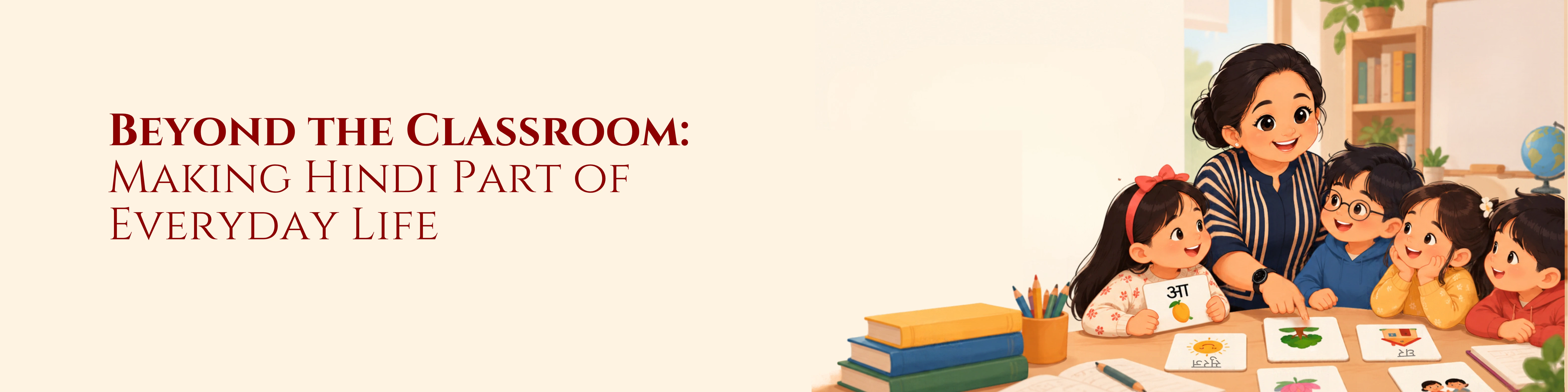
Beyond the Classroom: Making Hindi Learning for Kids a Part of Everyday Life
Youngsters don't just pick up a language by sitting down with a textbook and finishing a worksheet. They pick up new expressions in ordinary situations, participate in conversations, hear stories, and hear familiar words at home. These little events can have a significant impact on families raising children in bilingual environments.
When Hindi is used in daily life rather than just in class, learning the language becomes more organic for children. Simple routines can help your child connect with family, culture, and heritage while becoming more at ease with Hindi, regardless of whether they are growing up in Hong Kong, Singapore, or another part of the world.
The good news is that you don't have to dedicate hours each day or speak flawless Hindi. Your child will have more opportunities to listen, comprehend, and talk if you make a few deliberate adjustments to your family's routine.
Bring Hindi into Everyday Conversations
Youngsters must be given the chance to apply the language they acquire. Incorporating Hindi into regular discussions throughout the day is one of the simplest ways to generate these possibilities.
Start with brief sentences that your toddler can comprehend based on context. When making a meal, getting ready for school, or talking about the day's events, you might utilize Hindi.
For example:
Namaste (नमस्ते): Hello
Paani (पानी): Water
Khaana (खाना): Food
Chalo (चलो): Let’s go
Achha (अच्छा): Good or okay
Dhanyavaad (धन्यवाद): Thank you
Simple phrases like "Aap kaise ho" can also be introduced. "Yeh kya hai?" (What is this?), "Mujhe paani chahiye" (I want water), and "How are you?"
Teaching every word at once is not the aim. During the week, pick a few phrases and use them spontaneously. Encourage your child to answer in Hindi as they get to know them, even if at first they blend Hindi with English or another language.
Turn Everyday Routines into Learning Opportunities
Hindi can be introduced naturally through daily routines without making learning feel like an additional chore on a hectic schedule.
Name familiar meals for breakfast. Discuss colors and attire as you're getting dressed. When cleaning up, ask your youngster to use basic Hindi instructions to identify toys or set items in their proper locations.
Here are a few ways to get started:
At mealtimes: Use words such as roti (रोटी), doodh (दूध), seb (सेब) and garam (गरम).
While getting dressed: Practise colours such as laal (लाल), neela (नीला) and hara (हरा).
During playtime: Name toys, count objects and describe what your child is doing.
On the way to school: Talk about what you can see, such as a gaadi (गाड़ी), ped (पेड़) or ghar (घर).
Before bedtime: Ask your child to recall one new Hindi word from the day
These little exercises assist kids in making connections between words and actual things and experiences. They start to comprehend when and how to utilize each term rather than memorizing a list.
Make Storytime a Hindi Habit
Children can be introduced to language through stories. In an interesting manner, they introduce young students to new words, well-known sentence structures, characters, and scenarios.
Pick age-appropriate Hindi stories, picture books, or brief folktales. Start with stories with simple plots and clear images if your child is just starting out. Ask questions like "Yeh kaun hai?" (Who is this?) or "Billi kahaan hai?" (Where is the CT?) while pointing to the images and naming objects.
Not every statement needs to be translated. Sometimes a visual, gesture, or well-known example suffices to illustrate a word.
The same story can potentially be repeated over a few days. Children learn words through repetition and are better able to predict what will happen next. Ask them to finish a well-known phrase, identify a character, or recount a portion of the narrative in their own words.
Indian folktales can provide an extra link to cultural customs, beliefs, and narratives that have been passed down through the ages. They offer kids an opportunity to learn Hindi while learning tales that their parents and grandparents would recognize.
Use Songs, Rhymes and Movement
Language exercise is made more engaging and remembered by music. Children can listen to and eventually start singing along to Hindi rhymes and songs, which establish sounds, rhythm, and repeated phrases.
Select songs that fit your child's interests and age. Sing together as a nighttime ritual, while traveling, or during recreation. To assist your youngster in making the connection between words and meaning, incorporate hand gestures, clapping, or other basic activities.
By stopping before a well-known word and asking your child to finish the line, you can make the activity more engaging. When they hear a certain word or locate an item mentioned in the song, ask them to do something.
Through these exercises, kids can repeatedly hear Hindi without feeling like they're being examined. Over time, familiar sounds and expressions can become easier to recognise and use.
Make Play Part of Hindi Learning for Kids
Children have an incentive to communicate through play. They have the chance to listen, ask questions, make decisions, and explain what they are doing when they are having fun.
You can adapt simple games to support Hindi learning for kids at different ages and levels.
Try these easy activities at home:
Hindi treasure hunt: Place well-known items throughout the space and provide straightforward Hindi hints. Before teaching new words to your youngster, start with ones they already know.
Picture-card matching: Match pictures with Hindi words, such as phool (फूल), kitaab (किताब) and machhli (मछली).
Create a make-believe restaurant, kitchen, or store for pretend play. As they play, encourage them to name objects, practice greetings, and use simple sentences.
Ask your youngster to search the house for anything that is laal (red), peela (yellow), or neela (blue).
Build-a-story game: Take turns using basic Hindi words to create a character, setting, or action to a short story.
Keep the exercises brief and adaptable. On certain days, your youngster might like to talk more; on other days, just listening and word recognition might be plenty. Making Hindi a language kids are at ease learning is the goal.
Connect Hindi with Family and Cultural Traditions
Hindi can let children feel more connected to family and cultural customs for many families that live outside of India. When kids can use language to connect with the people and situations that are important to them, language becomes more meaningful.
Encourage your youngster to learn the names of family members and relationships, ask basic inquiries of relatives, and greet grandparents in Hindi. Introduce common phrases that your child can use during calls and visits if they communicate with Nana-Nani or Dada-Dadi on a regular basis.
There are numerous chances to learn Hindi during festivals and family gatherings. While assisting with age-appropriate activities, children can learn the names of native foods, decorations, attire, and customs.
For example, while preparing for Diwali, you could introduce words such as diya (दीया), roshni (रोशनी) and mithai (मिठाई). During a family celebration, invite your child to practise greetings or describe what they see.
Children learn from these encounters that Hindi is more than just a topic for school. It's also a method to participate in family life, tell stories, and show affection.
Introducing Reading and Writing at the Right Pace
Children can progressively experiment with reading and writing in Hindi but speaking and listening are crucial foundations.
Start by teaching newcomers how to recognize the Devanagari script using letters, images, and well-known words. Early practice can be facilitated by short tracing exercises, matching games, and illustrated worksheets.
Make sure your expectations are reasonable given your child's age and background. Before engaging in formal reading and writing practice, a youngster who is just starting to speak Hindi might want more time for vocabulary and listening exercises.
Introduce brief sentences and basic words as their confidence increases. Learning in the classroom can be connected to real-world experiences by having students write a word they use at home or read a picture book they are familiar with.
By teaching skills in a defined order and providing children with many opportunities to practice what they learn, a structured learning program can encourage this advancement.
Encourage Progress Without Correcting Every Mistake
Hindi may be understood by kids before they feel comfortable speaking it. Some may stop while looking for the proper term, respond in English, or use a combination of languages. This is a typical aspect of language learning.
Acknowledge your child's efforts and give them time to react. Instead of interrupting the conversation when they make a mistake, modeling the proper phrase organically.
For instance, if your youngster mispronounces a phrase, repeat it correctly and carry on speaking. This provides them with a helpful example without causing them to feel awkward when speaking.
Celebrate little victories, like learning a new word on your own, comprehending a question, or saying hello to a relative in Hindi. Every child's progress may be different, so instead of comparing their skills to those of other students, concentrate on developing their self-assurance and consistent involvement.
Above all, maintain the association of Hindi with good experiences. When kids feel encouraged and have purposeful reasons to use the language, they are more inclined to continue practicing.
Balance Home Practice with Structured Hindi Classes
Although daily exposure offers beneficial chances for Hindi practice, some kids also gain from directed instruction. They can improve their speaking, listening, reading, and writing abilities in a predetermined order with the aid of a systematic curriculum.
Finding a program that fits the child's age, skill level, and learning requirements can help families raising bilingual children maintain regular practice.
Children can study Hindi at Sanskriti through age-appropriate online courses that gradually improve language proficiency. Discussions, tales, novels, and other activities that reinforce what kids learn in class can help enhance learning at home.
It is not necessary for parents to become language instructors. It is their responsibility to provide practice opportunities, demonstrate interest in the child's development, and accommodate Hindi in daily family life.
Children can progress from identifying well-known terms to using Hindi more confidently with a combination of guided learning and frequent exposure.
Frequently Asked Questions
How can I help children learn Hindi at home?
Start with brief, well-known phrases that are used in everyday routines, playtime, and meals. Play easy word games, sing Hindi rhymes, and read picture books. Children can develop more at ease with the language via regular, stress-free practice.
What happens if my child responds in English rather than Hindi?
Give a positive response and carry on with the discussion. You can ask the child to attempt a word or phrase they are comfortable with after repeating their response in Hindi. Give youngsters time and encouragement because understanding often develops before they are ready to talk.
How much time should kids spend practicing Hindi each day?
No single regimen is effective for every youngster. Long practice periods may be more difficult to sustain than brief, frequent opportunities throughout the day. Activities should be tailored to your child's age, interests, and level of focus.
Can kids learn Hindi if their parents don't speak it well?
In addition to age-appropriate books, educational materials, and guided seminars, families can start with words and phrases that they feel comfortable using. In addition to learning with their kids, parents can concentrate on giving them constructive opportunities to hear and speak Hindi.
When should kids begin learning to write and read Hindi?
The child's age, level of linguistic proficiency, and preparedness all influence the ideal moment. Many kids gain from gradually being exposed to Devanagari while also improving their speaking and listening abilities. As their abilities grow, reading and writing exercises can be introduced gradually.
Make Hindi Part of Your Child’s Everyday World
It's not necessary to start teaching kids Hindi with a lengthy lesson or a ton of worksheets. A greeting in the morning, a story before bed, a song while driving, or a chat with grandparents can all start it.
Children have more opportunities to learn Hindi, try new vocabulary, and see its worth in their own lives when it is included into activities they already like.
Families may help children develop Hindi skills while fostering a long-lasting bond with language, family, and culture with perseverance, purposeful practice, and the appropriate learning assistance.
Discover a method that helps your child's learning process by looking through Sanskriti's online Hindi learning programs and resources.
Created by

Geetanjali Dhar
Meet Geetanjali Dhar: a dedicated educationist and the visionary Founder and CEO of
Sanskriti Group. She was inspired to start Sanskriti Group by her deep passion
for the Hindi language and her desire to share it with a global audience. Since
2006, Geetanjali has been passionately refining and customizing Hindi teaching
methods for a global audience. What began as a small initiative driven by her
enthusiasm for popularizing Hindi has now evolved into a cutting-edge, global
educational powerhouse.
Geetanjali’s journey as an educationist has
included realising her vision of creating a curriculum that not only taught the
language but also connected learners with Indian culture. She recognized the need for a more customized
and engaging approach to teaching Hindi, especially for students outside India.
After achieving remarkable success in Hong Kong and Singapore, Geetanjali
expanded her reach globally.
Geetanjali holds a postgraduate degree in
business management from Birla Institute of Management and Technology, a
diploma in hotel management from IHM Srinagar (under NCHMCAT), and is an
accredited educator in Hong Kong. Her outstanding work has been recognized with
numerous awards, including the ‘Woman of Influence Award’ by the
American Chamber of Commerce Hong Kong in 2019, ‘Pioneering Women Leader’
at the World Woman Leadership Congress in Mumbai, and Hong Kong’s Women
Leaders Award in 2018.
Today, Sanskriti’s innovative Hindi
teaching methods are accessible to students worldwide. This incredible growth
has benefited over 12,500 students from various nationalities and age groups.
The curriculum, designed for learners of all ages and stages, helps them
connect with the Indian culture and Hindi language.
As Sanskriti continues to grow, it
transforms future leaders and change-makers into multilingual global citizens.
Write a public review